Skip to product information
1 of 8

Space Cowboys

Time Stories

Out of stock
Regular price $39.00
Sale price $39.00 Regular price RRP $59.00

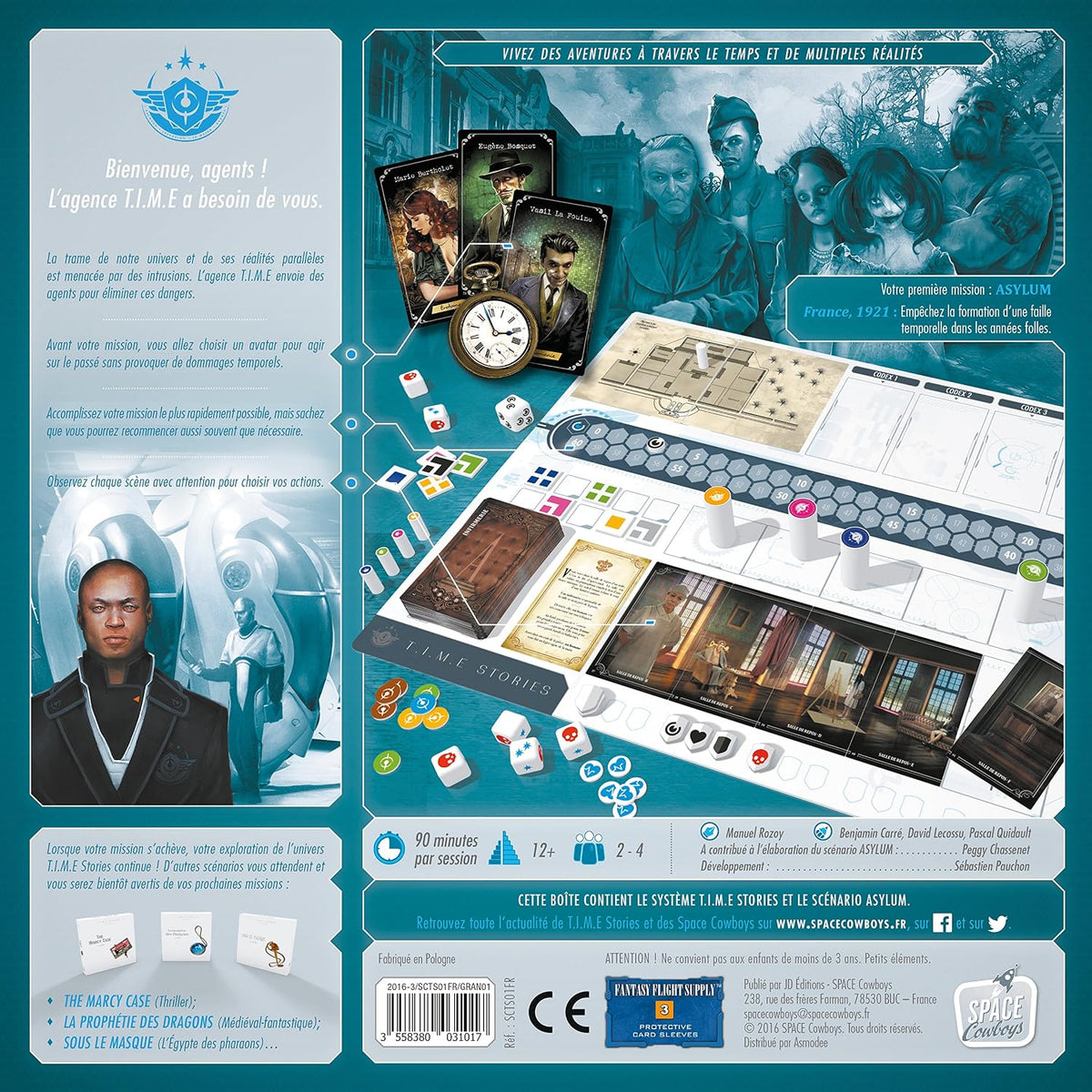
T.I.M.E Stories is a cooperative narrative board game for 2–4 players, recommended for ages 12+, with a typical scenario running 90–180 minutes at a medium complexity. As agents of the T.I.M.E Agency, players possess hosts across time and reality, exploring decks of cards, solving puzzles and repeating runs until the mission succeeds.

Players
2–4 players
Play time
2h
Age
Teens
Complexity
Medium
Sold out

About the Game

T.I.M.E Stories casts you and your team as agents of the T.I.M.E Agency, projected into the bodies of hosts in other times and realities to stop temporal faults. Each mission unfolds as a panorama of cards packed with clues, riddles, enemies and surprises. Every action costs Temporal Units, and when they run out your team is recalled to base to start the run again — armed with hard-won knowledge and chasing the perfect run.

The game suits 2–4 players, ages 12 and up, with a typical scenario lasting 90–180 minutes at a medium complexity. Notable mechanics include cooperative play, storytelling, dice-driven tests and a save system that lets you pause between sessions.

Designed by Manuel Rozoy and published by Space Cowboys in 2015, the base box contains the complete system plus the first scenario, Asylum. Later scenarios, including The Marcy Case and Expedition: Endurance, are sold separately and require this base game.

History

Designed by Manuel Rozoy and published by Space Cowboys in 2015, T.I.M.E Stories introduced a "decksploration" system in which each scenario is a deck of 120 or more cards, explored as a panorama. The base box includes the complete game system plus the first scenario, Asylum, with later scenarios such as The Marcy Case and Expedition: Endurance released separately to use the same core game.

Shipping

$15 flat shipping · FREE over $150

Shipping details

Watch: How to play

Rules of Time Stories

  • Set up the scenario deck as instructed, then each player picks an agent and chooses a host body (receptacle) to inhabit for the run.
  • The team places its pawn on the panorama and starts with a fixed pool of Temporal Units (TU), the game's time currency.
  • On your turn, move the group to a new card in the panorama; each player secretly reads the card section in front of them, then shares what they found with the team.
  • Moving between locations and many actions cost TU, so agree as a group before spending.
  • Challenges and fights are resolved with dice-driven tests, using your host's strengths to beat the required result.
  • Work together to unravel the scenario's clues, solve riddles and complete the mission objective.
  • When TU run out, the team is recalled to base: reset and start a new run, keeping everything you learned to plot a faster route.
  • The game ends when you finish the mission within a run's time limit; the save system lets you pause mid-scenario and resume later.

Strategy

  • Communicate constantly — each player only sees part of a location, so describe your card clearly rather than reading it word for word.
  • Guard your Temporal Units: don't wander to new cards without a reason, as every move burns time.
  • Take notes (or mental notes) on clues, codes and dead ends; knowledge from failed runs is your biggest advantage.
  • Match hosts to their strengths when facing dice tests — let the right character take the risky rolls.
  • On a repeat run, plan an efficient route and skip locations that offered nothing useful last time.
  • Don't rush the finale; make sure the team agrees on what the clues are pointing to before committing TU.
  • Use the save system between runs rather than mid-puzzle, so you resume with a clean plan.