Skip to product information
1 of 4

Alderac Entertainment Group

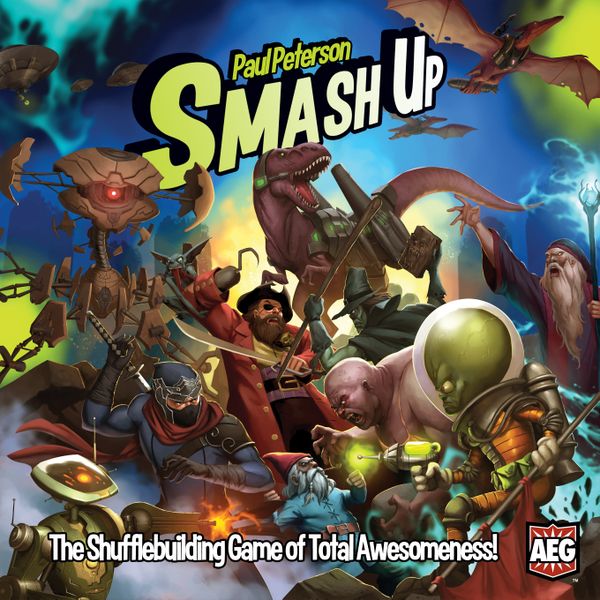
Smash Up

Low stock
Regular price $45.00
Sale price $45.00 Regular price RRP $50.00

Smash Up is Alderac Entertainment Group's 'shufflebuilding' card game: combine two 20-card faction decks — pirates, zombies, ninjas, dinosaurs and more — and battle to smash bases. For 2–4 players, around 45 minutes, medium-light complexity, recommended for ages 12 and up.

Players
2–4 players
Play time
1h
Age
Teens
Complexity
Medium

About the Game

Smash Up is the 'shufflebuilding' card game of gloriously odd alliances. Each player grabs two 20-card faction decks — pirates, zombies, dinosaurs, ninjas, aliens, wizards and more — shuffles them together, then competes to smash bases. A typical game sees minions piling onto bases while sneaky actions fling rival minions away, until a base breaks and points are scored. Scoring rewards first, second and third place on each base, so every smash is a three-way tussle. Every faction pairing plays differently, so zombie-dinosaurs feel nothing like pirate-aliens.

Smash Up plays 2–4 players in around 45 minutes, at a medium-light complexity, recommended for ages 12 and up. Notable mechanics include hand management, area majority and variable player powers.

Designed by Paul Peterson and published by Alderac Entertainment Group in 2012, Smash Up has grown into a long-running series with numerous expansions adding fresh factions to shuffle together.

History

Smash Up was designed by Paul Peterson and first published by Alderac Entertainment Group in 2012. Its 'shufflebuilding' hook — mashing two distinct faction decks into one — proved popular enough to spawn a long-running series of expansions and standalone sets, each adding new factions to mix and match.

Shipping

$15 flat shipping · FREE over $150

Shipping details

Smash Up

$45.00

Watch: How to play

Rules of Smash Up

  • Each player chooses two faction decks and shuffles them into one 40-card deck, then draws a starting hand of 5 cards.
  • Lay out a number of base cards equal to the player count plus one in the centre of the table.
  • On your turn you may play one minion and one action (in either order), plus any extra plays your cards grant.
  • Each base has a breakpoint: when the total power of minions on it meets or exceeds that number, the base is smashed and scores.
  • When a base scores, players are ranked by their total minion power there, and the base's points go to first, second and third place — so even a losing base is worth contesting.
  • After a base is scored, clear it away and draw a replacement base so the table stays full.
  • At the end of your turn, draw 2 cards; if your deck runs out, shuffle your discard pile to form a new deck.
  • The game ends when a player reaches 15 victory points; if several players cross 15 off the same base, the highest total wins.

Strategy

  • Pick complementary factions — pairing raw power with movement, destruction or extra plays tends to be more flexible than doubling up on one trick.
  • Don't pile everything onto one base; second and third place still score, so spreading your minions across two bases often earns more points.
  • Watch each base's breakpoint and try to be the one who pushes it over on your terms, ideally when rivals can't easily respond.
  • Hold a couple of action cards in reserve — moving, returning or destroying an opponent's minion right before a base scores can flip the standings.
  • Use your faction's discard and draw abilities to recycle key minions rather than letting your best cards sit in the discard pile.
  • Sometimes it's smarter to abandon a base you're losing and invest elsewhere instead of throwing good minions after bad.
  • Keep an eye on everyone's point totals — once a rival nears 15, prioritise denying them first place on scoring bases.