Skip to product information
1 of 2

2F-Spiele

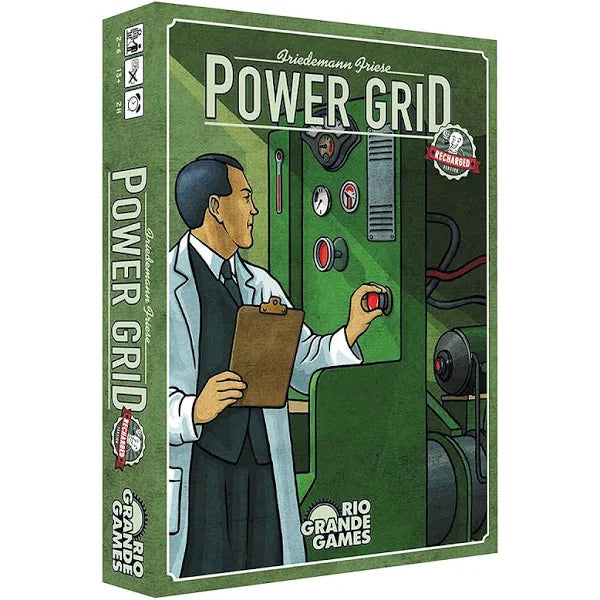
Power Grid

Out of stock
Regular price $73.00
Sale price $73.00 Regular price $100.00

SAVE $27.00

Power Grid is a medium-heavy economic strategy game for 2–6 players, recommended for ages 12+, with a typical play time of 90–120 minutes. Auction power plants, buy fuel in a fluctuating market and connect cities to supply the most power.

Players
2–6 players
Play time
Up to 2 hr
Age
Teens
Complexity
Hard
Sold out

About the Game

Every round of Power Grid is a tense balancing act: bid hard for the power plants you need, buy just enough coal, oil, garbage or uranium to fire them, then stretch your network across the map before rivals claim the cheapest connections. Every purchase can open the door to better plants for your opponents, so timing is everything.

Power Grid plays with 2–6 players over roughly 90–120 minutes. It is a medium-heavy strategy game recommended for ages 12+, built around auctions, network and route building, and a fluctuating commodities market.

Designed by Friedemann Friese and first released by 2F-Spiele in 2004, Power Grid is the updated edition of his earlier crayon game Funkenschlag, swapping crayon-drawn networks for pre-printed routes while keeping the market pressure and hard-fought auctions of the original.

History

Designed by Friedemann Friese and first released by 2F-Spiele in 2004, Power Grid is the updated edition of his earlier crayon game Funkenschlag. It replaces the original's crayon-drawn networks with pre-printed routes between cities, while retaining the fluctuating commodities market and the intense auction rounds that defined the earlier design.

Shipping

$15 flat shipping · FREE over $150

Shipping details

Watch: How to play

Rules of Power Grid

  • Choose a map side, give each player a colour, 50 Elektro and a supply of houses; set up the power plant market and fill the resource market.
  • Each round runs through five phases: determine player order, auction power plants, buy resources, build your network, then bureaucracy (income and restocking).
  • In the auction phase, players bid in turn order on power plants; each player may win at most one plant per round, and the opening bid equals the plant's number.
  • Resources (coal, oil, garbage, uranium) are bought in reverse player order, so trailing players buy first while prices are cheapest.
  • Build houses into cities in reverse player order too, paying the connection cost plus the city fee; the number of houses allowed per city grows as the game moves through its three steps.
  • At the end of each round, spend stored resources to fire your plants and earn income for every city you power, then restock the market and refresh the plant row.
  • The game ends when a player connects the required number of cities for your player count; the winner is whoever can power the most cities, with money breaking ties.

Strategy

  • Resist overbidding early: plants get better as the game goes on, and cash saved now funds expansion later.
  • Match plant capacity to your network — buying a big plant you can't yet fuel ties up money and hands opponents better options.
  • Remember that resources are bought in reverse turn order; sitting near the back of the pack early can mean cheaper fuel and less competition.
  • Buy fuel a round ahead where you can, since heavy demand from rivals can spike prices or empty the market entirely.
  • Try to spread across fuel types so you aren't fighting another player for the same scarce resource every round.
  • Expand towards cheap connections and claim key routes before rivals, but don't trigger the next game step until you're ready to benefit from it.
  • Keep enough Elektro in reserve for the final rounds — the winner is decided by cities powered, not plants owned.