Skip to product information
1 of 6

Steve Jackson Games

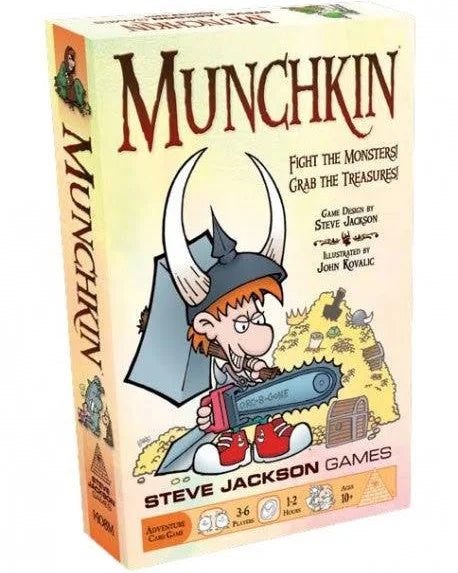
Munchkin - Shiny Box Edition

Low stock
Regular price $40.00
Sale price $40.00 Regular price RRP $45.00

Munchkin – Shiny Box Edition is Steve Jackson's award-winning card game of dungeon-crawling, loot-grabbing and backstabbing your friends. A light, chaotic game for 3–6 players aged 10+, typically lasting 60–120 minutes, built on hand management, dice-driven combat and plenty of 'take that' play.

About the Game

Munchkin turns dungeon-crawling into a gleefully ruthless race: kick open the door, fight everything from the Potted Plant to the Plutonium Dragon, grab absurd loot like the Horny Helmet and the Chainsaw of Bloody Dismemberment, and backstab your friends when they beg for help. First to reach level ten wins, so expect everyone to gang up on the leader.

Munchkin – Shiny Box Edition plays with 3–6 players aged 10 and up, usually over 60–120 minutes. It's a light, chaotic card game built on hand management, dice-rolling combat and 'take that' negotiation, with shifting alliances and shameless betrayals every turn.

Designed by Steve Jackson and illustrated by John Kovalic, Munchkin was first released by Steve Jackson Games in 2001, winning the Origins Award for Best Traditional Card Game and spawning countless sequels and spin-offs. This edition packages the classic base game.

History

Designed by Steve Jackson and illustrated by John Kovalic, Munchkin was first published by Steve Jackson Games in 2001 and won the Origins Award for Best Traditional Card Game. Its tongue-in-cheek skewering of hack-and-slash roleplaying made it a modern classic and spawned dozens of sequels, expansions and themed spin-offs. This edition packages the original base game.

Shipping

$15 flat shipping · FREE over $150

Shipping details

Munchkin - Shiny Box Edition

$40.00

Watch: How to play

Rules of Munchkin - Shiny Box Edition

  • Setup: Shuffle the Door and Treasure decks separately, deal each player four Door and four Treasure cards, start everyone at Level 1, and choose a start player.
  • Kick open the door: Reveal the top Door card. Curses apply immediately; classes, races and similar cards may be played or kept; monsters trigger combat.
  • No monster: If you did not reveal a monster, loot the room by drawing another Door card face down into your hand, then move to end of turn.
  • Combat: Compare your Level plus carried item bonuses and played one-shots against the monster's Level plus modifiers; other players may help for a price or interfere with curses and monster enhancers.
  • Win or flee: Beat the monster to gain its Level(s) and draw the listed Treasures; if you cannot win, roll to Run Away (usually 5 or better) or suffer the monster's Bad Stuff.
  • End of turn: If you hold more than five cards, give the excess to the lowest-Level player as Charity, discarding them if that is you, then pass play left.
  • Winning: The first player to reach Level 10 wins; in the classic game the winning level normally must come from killing a monster unless a card says otherwise.

Strategy

  • Play usable items early, but keep one emergency one-shot or Run Away aid rather than spending everything on the first monster.
  • Do not sprint to the lead with an empty hand; being high-Level with no interference cards invites the whole table to stop you.
  • Check equipment limits before committing to gear: one each of headgear, armour and footgear, plus limited hands, so duplicate bonuses may be dead weight.
  • Sell items for a Level only when the level beats the lost bonus; remember selling will not normally award the winning tenth level.
  • When asking for help, offer a clear Treasure split that still leaves you better off; if you are helping, take payment that advances your own plan.
  • Save curses, monster enhancers and backstabs for fights that matter, especially when someone is close to Level 10.
  • Choose Run Away when the likely Bad Stuff is worse than losing the loot; failed heroics can cost levels or gear.
  • Use Charity deliberately: avoid ending over five cards when a rival is the lowest-Level player, and remember you discard extras if you are lowest.