Skip to product information

Lookout Games

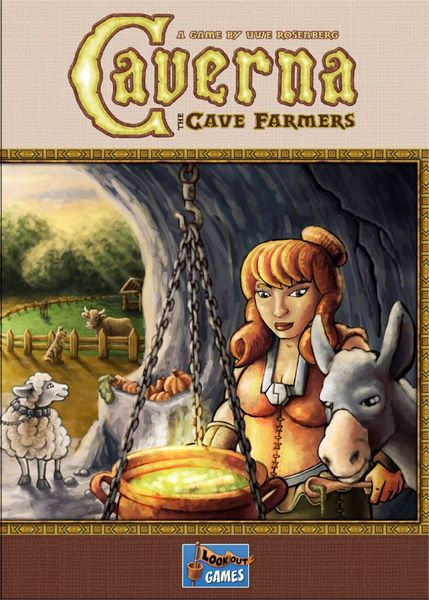
Caverna - The Cave Farmers

Out of stock
Regular price $109.00
Sale price $109.00 Regular price $150.00

SAVE $41.00

Caverna: The Cave Farmers is a medium-heavy worker-placement game for 1–7 players, aged 12+, running about 30 minutes per player. Guide your dwarf family to clear forest, sow fields, raise animals, mine the mountain and furnish your cave — the most efficiently developed home board wins. A full solo mode is included.

Players
1–7 players
Play time
Up to 4 hr
Age
Teens
Complexity
Hard
Sold out

About the Game

Lead a bearded dwarf family as you carve a thriving homestead out of the mountainside: dig ore and ruby mines, furnish caverns as dwellings and workshops, clear the forest for fields and pastures, and forge weapons to send farmers on expeditions for bonus loot. Each turn, every family member takes a single action, so choosing where to place your workers — and when to grow your family — drives a tense, satisfying blend of farming and tunnelling.

Caverna: The Cave Farmers plays 1–7 players, runs roughly 30 minutes per player, and is recommended for ages 12+. It is a medium-heavy game built on worker placement and tile placement, with unchosen action spaces accumulating goods, plus a solo variant for learning the 48 furnishing tiles.

Designed by Uwe Rosenberg and published by Lookout Games in 2013, Caverna is a complete redesign of Agricola, swapping its card decks for buildings and adding mining, weapons, expeditions, and new dogs and donkeys.

History

Designed by Uwe Rosenberg and published by Lookout Games in 2013, Caverna: The Cave Farmers is a complete redesign of his earlier farming game Agricola. It replaces that game's card decks with a shared set of buildings and 48 different furnishing tiles, while adding a cave side to your board with ore and ruby mines, weapon forging, and expeditions for bonus items and actions. Two new animals, dogs and donkeys, also join the farm.

Shipping

$15 flat shipping · FREE over $150

Shipping details

Watch: How to play

Rules of Caverna - The Cave Farmers

  • Setup: Each player takes a home board with two dwarfs in their dwelling and their starting goods; lay out the action boards, sort the furnishing tiles, and prepare the round cards for the game's 12 rounds.
  • Reveal a round: Flip the next round card to open a new action space, then add the shown resources to each accumulating space on the board.
  • Place workers: In turn order, place one family member on an empty action space and take that action immediately — clear forest, plough and sow fields, fence pastures, gather animals, dig tunnels and caverns, build mines, or furnish rooms.
  • Accumulating spaces: Any space nobody claims keeps its goods and gains more next round, so ignored actions steadily grow more tempting.
  • Harvest: Once all dwarfs are placed, collect ripe crops, feed each dwarf (two food per adult, one for a newborn), and breed any paired animals sharing a pasture.
  • Grow and explore: Furnish dwellings to grow your family for extra actions, and forge weapons to send armed dwarfs on expeditions for loot such as ore, rubies, and animals.
  • Objective: Build a balanced homestead — family, crops, animals, mines, rubies, and furnished caverns all score, while empty board spaces and missing goods types cost points.
  • Game end: After the final round's harvest, tally scores and subtract penalties; the highest-scoring homestead wins.

Strategy

  • Secure a steady food engine early — sown fields or a small breeding herd free you from scrambling for food at every harvest.
  • Grow your family when you can reliably feed it; an extra action each round is powerful, but unfed dwarfs cost you points.
  • Mix farming and tunnelling rather than specialising, since scoring rewards breadth and empty home-board spaces carry penalties.
  • Watch accumulating action spaces — a space loaded with several rounds of goods is often worth changing your plans for.
  • Choose furnishing tiles that support your direction: dwellings enable family growth, while workshops convert surplus goods into food or points.
  • One or two weapon-forged expeditions can patch gaps in your economy, grabbing rubies or animals you can't easily produce yourself.
  • Rubies are flexible — they score well and can substitute for other goods, so a ruby mine pays off if you can work it consistently.
  • Plan a late-game tidy-up: filling unused spaces and covering missing animal types before the final scoring can swing a close game.